- 29th September, 2026
- By Adam Gatt
7 Warning Signs Your Electrical Switchboard Needs Attention (Before It Stops Production)
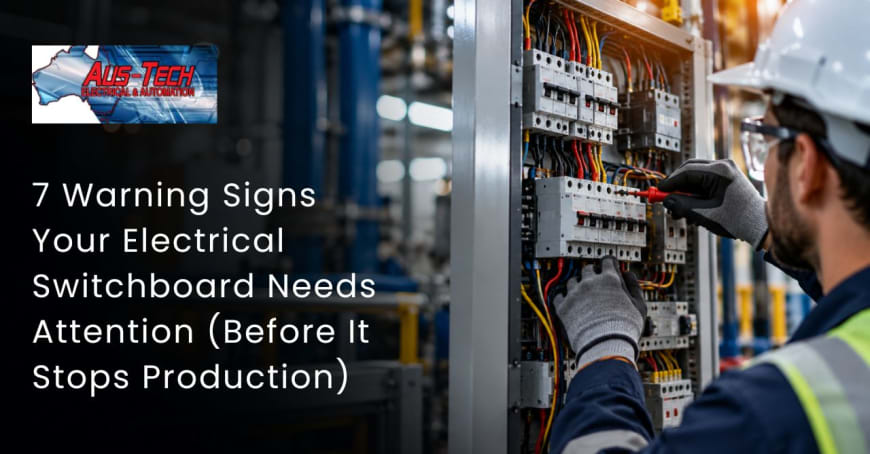
Most plant managers don't think about their electrical switchboard until a breaker trips mid-shift and the whole line stops. But your electrical switchboard is a critical part of your facility's power distribution system. It feeds every motor, conveyor, control panel and packing machine on your floor. When something starts to go wrong, there are often warning signs first. The trick is knowing what to look for.
Common warning signs include repeated breaker trips, overheating, unusual sounds or smells, erratic machine behaviour, increased electrical loads and ageing components. Identifying these issues early can help reduce the risk of unexpected failures and production interruptions.
Missing those signs can be expensive. ABB's 2025 research, based on a survey of 3,600 senior industry decision-makers, found that 44 per cent of respondents experience equipment-related interruptions at least monthly, while 14 per cent experience them every week. Most estimated these sudden disruptions cost more than thousands or lakhs per hour.
You don't need to be a global manufacturer to feel the impact. A few hours of lost production can affect output, delivery schedules, labour costs and customer commitments. Here are seven signs your electrical switchboard needs attention, and what to do about them.
Why Your Electrical Switchboard Deserves More Attention
Every switchboard has a service life. Most plants also change over the years. New machines get added, production runs longer, and electrical loads increase, often on a board designed for a very different plant. Components that ran comfortably ten years ago may now be working closer to their limits every day.
A poorly performing switchboard can lead to safety hazards, failed circuit protection and power interruptions. In an automated plant, one failure can stop several machines at once. Regular inspections and preventive maintenance can help identify developing problems before they become unexpected production failures.
7 Warning Signs Your Electrical Switchboard Needs Attention
1. Circuit breakers keep tripping
A breaker that trips occasionally is doing its job. One that trips regularly is telling you something. The circuit may be overloaded, a machine may be developing a fault, or the breaker itself may be failing.
Investigate repeated tripping rather than treating it as a nuisance. The underlying cause could involve an overload, short circuit, equipment fault or problem with the protective device. Resetting it and carrying on only hides the problem until it causes a longer stoppage.
2. Hot, discoloured or burnt components
Brown or blackened marks around terminals, melted insulation or visibly damaged components can all indicate excessive heat. Heat can result from loose connections, overloaded circuits or deteriorating components. Left alone, excessive heat can damage insulation and increase the risk of electrical failure or fire.
Do not physically handle a switchboard to check whether components feel hot. Thermal imaging gives qualified professionals a safer way to identify abnormal temperature differences across electrical equipment while it is operating.
3. Buzzing, crackling or a burning smell
A healthy switchboard should not produce unusual buzzing or crackling sounds. These noises can point to loose connections, arcing or other electrical faults, while a burning or "hot plastic" smell should never be ignored.
If you notice unusual sounds or smells around an electrical switchboard, keep people clear and contact a licensed electrician straight away. Do not attempt to investigate or repair an energised switchboard yourself.
4. Machines and control panels are behaving erratically
Power problems don't always show up at the switchboard. You might see flickering lights, motors struggling to start, PLCs resetting or faults on a control panel that seem random.
These issues can sometimes be associated with problems in the electrical supply feeding the equipment. Before replacing expensive machine components, it is worth checking for an upstream electrical issue.
Looking at the switchboard, control panels and connected equipment together can also help distinguish a machine fault from a wider electrical problem.
5. You've added machinery but not upgraded the board
Expanding production is good news, but each new machine can increase the installation's electrical demand.
If you've connected new equipment to the existing board without a proper load assessment, you may be running closer to capacity than expected. The switchboard, protective devices, busbars, cables, and other parts of the electrical installation must remain suitable for the additional load.
A switchboard upgrade, and sometimes power factor correction, may be needed to support growth safely. Before adding significant equipment, have a qualified professional assess the existing electrical installation.
6. The board is old and hard to maintain
Older boards may use outdated protection devices, spare parts may be difficult to source, and the layout may make maintenance slow and awkward. A board modified repeatedly over many years may also need closer assessment to determine whether its current configuration remains suitable.
Current low-voltage switchboard requirements reference the AS/NZS 61439 series, while electrical installations must also meet applicable requirements under AS/NZS 3000 and Victorian electrical safety regulations.
If your board has been patched, modified or expanded many times over the years, it may be worth having its condition, capacity and protection assessed before a problem forces an emergency upgrade.
7. No switchboard thermal imaging report in the last 12 months
You can't see this with the naked eye, and that's exactly the point. Some developing electrical faults can produce abnormal heat patterns before they result in more serious failures.
Thermal imaging can help identify temperature differences associated with issues such as loose connections, overloaded circuits and some deteriorating electrical components.
Some insurers may request thermographic scans of electrical switchboards as part of risk assessment or insurance requirements. If your policy requires regular thermal imaging, keeping reports current can help demonstrate that electrical risks are being monitored.
If you don't know when your switchboard was last thermally inspected, check your maintenance and insurance requirements and discuss an appropriate inspection interval with a qualified electrical professional.
How a Switchboard Thermal Imaging Report Catches Problems Early
A switchboard thermal imaging report uses an infrared camera to show temperature differences across your board while it's operating. Loose terminals, overloaded circuits and some failing components can produce abnormal heat patterns that may be identified before they develop into more serious failures.
Because thermal imaging can generally be performed while equipment is operating, the scan itself does not normally require a shutdown. For the most useful results, your plant should ideally be operating under a representative production load.
The inspection is non-invasive and provides a visual indication of temperature differences that may not be visible during a standard inspection. You'll receive a report with annotated images, temperature readings and clear recommendations.
That lets you plan repairs during scheduled maintenance instead of scrambling after a breakdown. Austech recommends thermal imaging inspections every six to twelve months for many facilities, although the appropriate frequency can vary depending on factors such as electrical load, operating conditions, asset criticality and maintenance requirements.
Switchboards, Control Panels and Machine Maintenance Work Together
Your electrical switchboard doesn't work alone. Power flows from the main board through distribution boards to the control panels on each machine, and a weakness at any point can affect the whole chain.
A loose connection on the main board can look like a machine fault. A failing contactor in a control panel can also affect the circuits feeding the equipment.
That's why the most reliable plants treat switchboard care as part of their wider machine maintenance program, not a separate job. Scheduled inspections, thermal imaging and preventive servicing, done together, give you a more complete picture of your electrical health.
They also make it easier to distinguish between electrical supply issues and individual machine faults, helping maintenance teams address problems before they become unexpected production interruptions.
How Austech Keeps Your Electrical Switchboard Running
Since 1976, our family-owned business has helped Australian manufacturers keep their plants running, serving more than 1,500 clients across industries such as food and beverage, automotive, and plastics.
For manufacturers and industrial facilities in Melbourne, regular switchboard inspections can be particularly useful where production equipment runs continuously, or electrical loads have changed as the site expands. Our team supports your electrical switchboard across its whole life:
Switchboard design, installation and upgrades, using proven products from leading manufacturers
Switchboard thermal imaging reports, carried out by fully licensed A-grade electricians and delivered the next day.
Design and build of industrial control panels suited to your machines and processes
Machine maintenance and plant maintenance programs that catch problems before they cost you production
Our electricians are full-time employees who have been with us for many years, so you deal with people who know your site. And because we fix issues as well as find them, there's no gap between the report and the repair.
Conclusion
Your electrical switchboard gives you plenty of warning before it fails, as long as someone is looking. Frequent tripping, heat, unusual noise, erratic machines and an ageing board can all indicate that your electrical system needs attention.
Regular inspections and preventive maintenance can help identify developing issues before they become expensive production interruptions. Thermal imaging is one tool that helps maintenance teams identify abnormal heat patterns while equipment is operating, allowing them to investigate and plan for potential problems before they cause an unexpected failure.
Not sure where your switchboard stands? Contact Austech to book a switchboard thermal imaging report or an on-site inspection, and keep your production running with confidence.
FAQs
How often should an industrial electrical switchboard be inspected?
The appropriate inspection frequency depends on factors such as the switchboard's age, electrical load, operating environment, asset criticality and maintenance requirements. Austech recommends thermal imaging inspections every six to twelve months for many facilities, while higher-risk or critical sites may require more frequent assessment.
Is a switchboard thermal imaging report a legal requirement in Australia?
Thermal imaging is not generally a universal legal requirement for every electrical switchboard in Australia. However, specific insurance policies, maintenance programs or site requirements may call for thermal imaging. Electrical installations and maintenance work must also comply with applicable electrical safety legislation and standards.
What's the difference between an electrical switchboard and a control panel?
An electrical switchboard distributes electrical power from the supply to circuits across a site. A control panel sits on or near a machine and manages how that machine operates, commonly using components such as PLCs, contactors and drives. Both require appropriate inspection and maintenance because faults in one part of the system can affect connected equipment.
Does my plant need to shut down for a thermal imaging inspection?
A shutdown is not normally required for a thermal imaging scan because the equipment can generally be inspected while operating. For useful results, the plant should ideally be running under a representative production load. Any inspection of electrical equipment must be carried out by appropriately qualified personnel using suitable safety procedures.
What can thermal imaging detect in an electrical switchboard?
Thermal imaging can identify abnormal temperature patterns associated with issues such as loose connections, overloaded circuits and some deteriorating electrical components. It can provide an early indication that further investigation or maintenance may be required.
When should an electrical switchboard be upgraded?
A switchboard may need an upgrade when it has insufficient capacity, obsolete components, repeated faults, limited spare capacity or significant changes in the site's electrical load. A qualified electrical professional should assess the existing installation before an upgrade is planned.